 Found it useful? Share
 Share on Facebook
 Share on X
 Share on LinkedIn
 Share via Email
 Share on WhatsApp
 Print Article
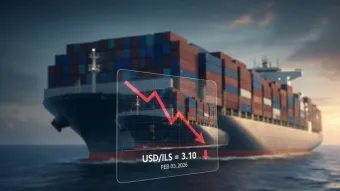
Data indicates that as of May 2026, the US Dollar exchange rate continues to break historic lows, plunging below the 3 NIS threshold, with no horizon for stabilization at last year's price levels.
For the international freight forwarding and customs brokerage industry, where every cent impacts financial stability, this represents a "currency trap" forcing companies to adopt emergency operational measures to ensure continued service continuity for the Israeli economy.
While a strong Shekel is often presented in public discourse as positive news, the reality behind the scenes of the supply chain is entirely different. In just one year, the American currency has lost approximately 22% of its value against the Shekel. This is a freefall from a level of 3.81 NIS to current levels hovering around 2.95-2.98 NIS.
This reality is not a "statistical fluctuation," but an economic event that is grinding the margins of shipping companies to the bone, placing them under real operational risk.
The "Scissors Effect": The Trap Between the Dollar and the Shekel
The structural difficulty currently facing customs brokers and freight forwarders stems from what is known in the industry as the "Scissors Effect." Most of the income for these companies, based on freight prices and international handling fees, is denominated in Dollars. In contrast, the central expenditure components that enable their operations, including salaries for thousands of professional employees, fuel for truck fleets, rent for logistics warehouses in ports, government fees, and municipal taxes, are all paid in Shekels and linked to the Israeli Consumer Price Index, which shows no signs of stopping.
When the Dollar is traded at such low levels, every Dollar entering the company's coffers is "worth" significantly fewer Shekels than in the past, while Shekel-based bills remain rigid or even become more expensive. This gap cannot be bridged through internal efficiency measures alone, as it represents a broad erosion of nearly a quarter of the company's real income.
Professional sources warn that in such a situation, without updating pricing mechanisms, the operations of many companies in the sector could become loss-making in the immediate term.
CAF and FSF Surcharges: Various Models in the Field
In light of this forced economic reality, we have witnessed in recent days independent decisions by leading freight forwarding and customs brokerage firms to update their pricing policies. The goal is to bridge the currency gaps through dedicated surcharges such as CAF (Currency Adjustment Factor) or FSF (Financial Stabilization Fee).
It should be noted that although the distress is industry-wide, the methods of coping are individual and diverse, with each company examining the model best suited to its currency exposure.
It further appears that some customs brokers and international forwarders have chosen a percentage-based surcharge model, usually ranging around 1.5% of the freight value, alongside a "floor price" (minimum) ranging between $25 and $45 per shipment to ensure the coverage of operational costs for small files.
Other companies have preferred a Flat Fee model ranging around $25 per Bill of Lading, regardless of the freight value.
A third model observed in the field focuses on pricing by weight or volume, intended primarily for air shipments (e.g., a fixed amount per kg) or Less than Container Load (LCL) sea shipments, allowing for greater precision according to the complexity of cargo handling.
Between Media Populism and Operational Responsibility
Industry professionals note that these moves are a genuine step intended to prevent the financial collapse of customs brokers and forwarders. They claim that without these brakes, the level of service to importers and exporters would be fatally harmed—from response times and the quality of professional regulatory handling to the ability to release cargo from ports on time.
These statements come against the backdrop of recent publications in the national press suggesting a whim by customs brokers intended to improve profitability through price hikes—claims defined by industry professionals as populist and divorced from reality.
"These surcharges are not additional profit," a customs broker noted in a conversation with the PORT2PORT editorial team, "but the oxygen that allows companies to pay salaries and maintain logistics systems. The transition to explicit surcharges was made with full disclosure, aiming to allow the cargo owner to understand the economic complexity that has arisen and to ensure that their supply chain is not interrupted due to the instability of service providers."
The Need for a Currency Adjustment Factor: A Comparative View (May 2025 vs. May 2026):
| Comparative Aspect | May 2025 (Pre-Crisis) | May 2026 (Current Low) | Economic Significance |
|---|---|---|---|
| Exchange Rate (USD/ILS) | 3.81 NIS | 2.97 NIS | Approx. 22% drop in income value |
| NIS Income (per $10,000) | 38,100 NIS | 29,700 NIS | Cash flow loss of 8,400 NIS |
| NIS Operating Expenses | Fixed / CPI-linked | Fixed / CPI-linked | Total erosion of profit margin |
| Surcharge Necessity Status | Not Required | Critical for Financial Stability | Ensuring customer service levels |
* Data based on average exchange rates and standard expense structures in the shipping and customs industry.