 Found it useful? Share
 Share on Facebook
 Share on X
 Share on LinkedIn
 Share via Email
 Share on WhatsApp
 Print Article
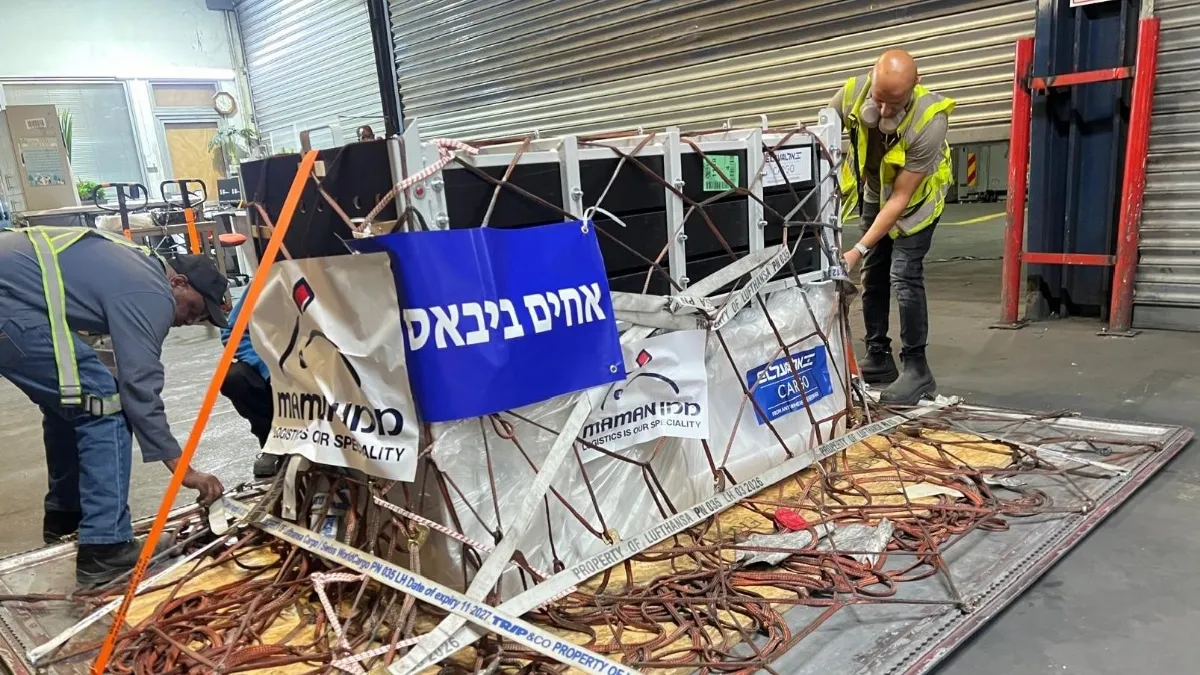
An extraordinary logistics operation in the field of animal transport was completed the day before yesterday with the landing of El Al cargo flight LY860 from the Czech Republic, carrying a hippopotamus destined for a zoo in northern Israel. The operation, managed by the "Bivas Brothers" company, required special preparation due to the animal's physiological complexity and the need to comply with strict IATA LAR (Live Animals Regulations) standards for transporting wild animals of exceptional volume and weight.
The execution of the operation at this specific time is not coincidental. Logistics planning of this type takes many months and includes obtaining international CITES permits, complex veterinary coordination, and dedicated cargo engineering. The relative lull in the "Lion's Roar" security situation and the calm in the airspace created the operational window of opportunity to complete the transfer, which requires a sterile work environment free of supply chain delays.
The Bivas company noted that transporting a hippopotamus is considered one of the most complex operational challenges in the industry, both due to its concentrated weight—approximately 2 tons including the steel cage—and the sensitivity of its epidermis to dryness. During the flight, logistics teams were required to manage an active hydration protocol involving continuous water spraying, while maintaining strict temperature and pressure control in the cargo hold.
Additionally, the cargo's placement in the aircraft's belly was carefully planned with El Al's Load Control department to ensure the stability of the center of gravity.
Yossi Bivas, one of the owners of "Bivas Brothers," noted that the key to the project's success lay in the synchronization between the dedicated cage systems and the ground transport chain. According to him: "Such an operation is not born in a day; it involves months of meticulous logistics preparations. In the field of Live Animals (AVI), and especially with large mammals, there is no room for error. We had to ensure that environmental and security conditions would allow for the fastest possible 'green corridor,' as any delay on the way due to the security situation could have put the animal under critical stress."
Upon unloading the cargo at Ben Gurion Airport using heavy lifting equipment, the cage was transferred to the Maman terminal and from there by land transport in a truck equipped with advanced shock-absorption systems.
The operation concluded with the convoy's arrival at the zoo and the release of the hippopotamus into its new enclosure, after completing all required regulatory coordinations.