 Found it useful? Share
 Share on Facebook
 Share on X
 Share on LinkedIn
 Share via Email
 Share on WhatsApp
 Print Article
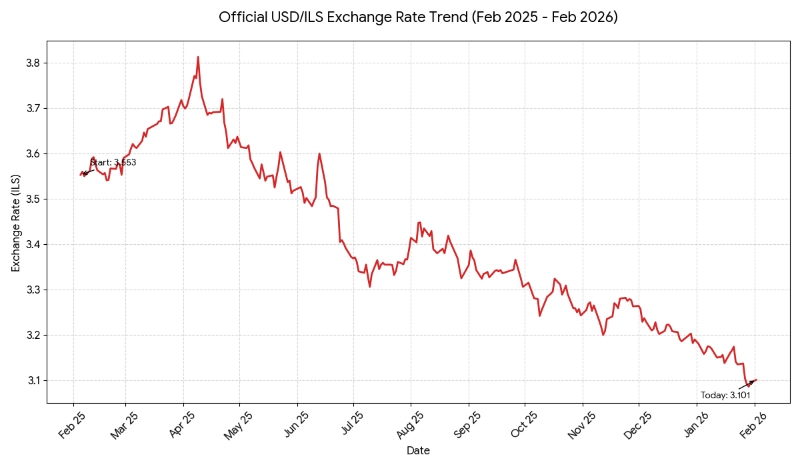
While the Israeli economy boasts a strong Shekel, the numbers behind the scenes of the freight forwarding and logistics industry tell a completely different story. Bank of Israel data reveals that since the peak on April 9, when the exchange rate stood at 3.813 ILS, the Dollar has lost nearly a fifth of its value against the Shekel, reaching a level of 3.101 ILS. This reality creates "margin erosion" that threatens the stability of forwarding companies and may now lead them to widely adopt the "Shipping Exchange Rate" mechanism as a survival tool.
"The Entire Industry is in Great Danger"
Feelings among company heads are difficult. In a conversation with the owner of one of Israel's largest freight forwarding companies, a worrying picture emerges. "It's truly crazy," he says. "Just a year ago, in February, the Dollar was still around 3.6. Today we are at 3.1. This is not a localized difficulty; if this trend continues, exporters will go bankrupt. Our entire industry is in very great danger."
It should be noted that the distress stems from the impossible gap where most of the international forwarders' revenues are in Dollars, while their central expenses - including salaries, rent, and municipal taxes - are in Shekels and are rigid. The drop of nearly 19% from the peak has wiped out the net profit line, leaving many companies financially bleeding.
The Legal Legitimacy of the "Shipping Exchange Rate"
Against the backdrop of the economic crisis in the industry, Adv. Shmuel Grossman, legal advisor to the Israeli Federation of Forwarders and Customs Clearing Agents, issued a critical clarification regarding a new District Court ruling. The ruling, given within the framework of a class action request, grants legitimacy to the "Shipping Exchange Rate" mechanism for the first time, but sets clear boundaries for it.
In his letter, Adv. Grossman emphasizes that since this is a Business-to-Business (B2B) relationship to which the Consumer Protection Law does not apply, the court chose to approve an arrangement allowing the use of a "Shipping Exchange Rate." However, the legal validity of the rate is contingent upon comprehensive "Full Disclosure." According to the ruling, forwarding companies must transparently publish the rate-setting mechanism on their website and include an explicit reference to this publication in every agreement or price quote provided to customers.
According to Grossman, meeting these conditions will not only facilitate the clarification of the mechanism for customers but may also serve as a significant barrier against future class action lawsuits on the matter.
Caution Regarding Competition Law
Adv. Grossman warns that despite the tailwind from the court, every company must make the decision regarding the rate level and its implementation method completely independently. He emphasized that any coordination between companies or a broad recommendation could be considered a restrictive arrangement (cartel) and lead to criminal sanctions.