

The demand to bring a significant volume of containers to Eilat Port is detached from reality. This is the claim made today by the management of Eilat Port in response to the state's claim that the port did not meet the threshold conditions for extending the license for an additional 10 years, which require bringing a significant volume of containers to Eilat Port.
In a letter sent today to the CEOs of the Ministries of Transportation and Finance through attorney Raz Nazri, Avinoam Segal-Elad, Nadim Aboud and Danny Freiman of the Pirone Law Firm, the port management clarifies that the state's claims completely ignore the objective and exceptional circumstances in which the company has been operating in the past two years due to the outbreak of the global shipping crisis in the Red Sea and threats and attacks by the Houthis towards Israel. These events have led to an almost complete cessation of ship movement to the port and the cessation of its main activity, a situation which, according to the port, has not received any response from the various government bodies to which it has turned over time.
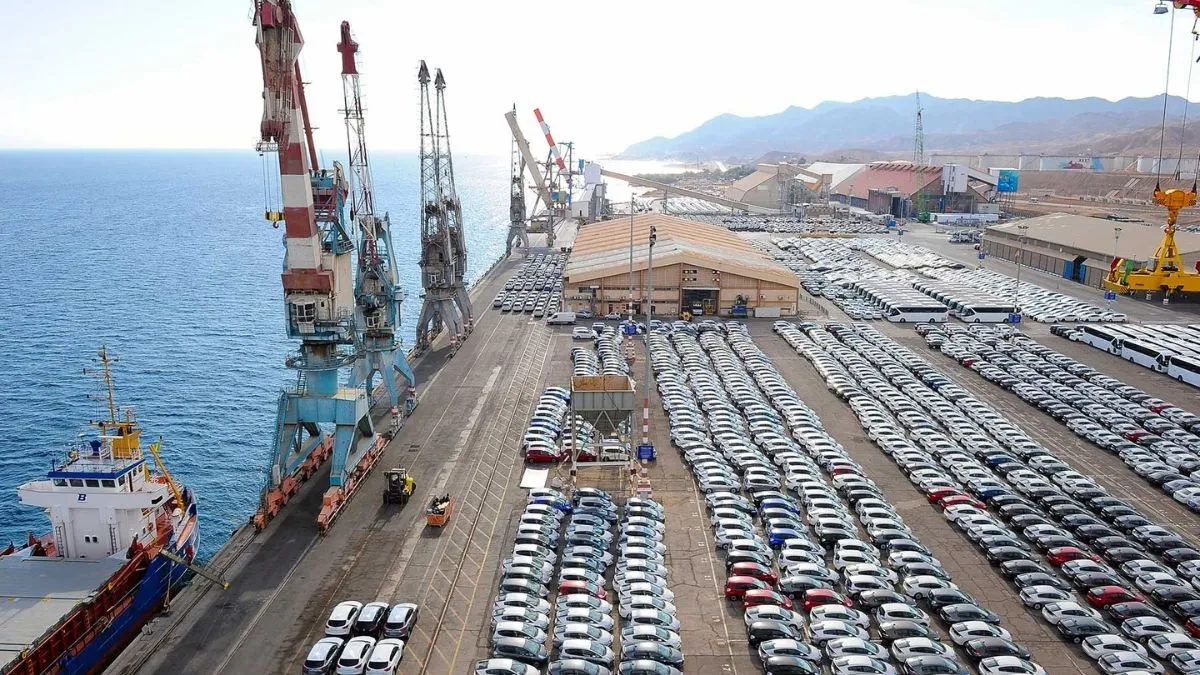
At the center of the dispute is the state's claim that the port did not meet the goal of an average annual container handling of 65,000 TEU in 2022-2024. Eilat Port clarifies that this goal is not realistic due to structural factors that are not dependent on the company, primarily the land transportation costs from Eilat to the center of the country, which amount to about $1,200 - a cost sometimes higher than sea transportation from China to Mediterranean ports. In the absence of a railway to the port that would allow a significant reduction in costs, a condition that the state has defined as critical in the past, there is no economic feasibility for importers and exporters to use its services. In addition, the draft restrictions (depth of the berths) at Eilat Port, which are less than 14 meters, do not allow the anchoring of modern container ships, causing the main shipping lines to skip the port.
Despite these obstacles, the port presented a detailed breakdown of active and exceptional efforts it has made over the years to promote container activity, actions that are not characteristic of port corporations in routine. These efforts included numerous approaches to shipping companies to build 'logistic packages' and financial investment in an attempt to establish a supply chain for the Eilat-Aqaba line. The port even chartered a container ship named EXE OTTER for the purpose of operating a feeder line, established a dedicated marketing company (MED RED) and recruited a senior manager with experience in shipping. In addition, options for importing malt from the Palestinian Authority, agricultural exports from the Arava, agricultural imports from Sudan, and even the establishment of industrial projects such as a sugar factory in the Taman area were examined. All these attempts failed due to the lack of economic feasibility for customers and high land transportation costs in the absence of railway infrastructure.
The port management emphasizes that the fact that the targets are not achieved was well known and in real time to all relevant state bodies for years, and despite this, no claim was ever raised against the port on this matter. Both the Shipping and Ports Authority (RASPA) and Israel Ports Company (IPC) held all the relevant information and did not take the steps available to them in the letter of authorization, as it was clear that these conditions could not be met despite the port's efforts. Moreover, in a review conducted by RASPA in 2024 to verify the fulfillment of the license conditions, no claims were raised regarding non-compliance with the container handling volumes. This conduct created a legitimate reliance on the port that the state recognizes the business reality and the objective limitations. Moreover, the port claims that even in a study conducted as early as 2018 by the Kohelet Forum, which examined competition in ports, it was claimed that 'the letter of authorization imposes competition under non-equivalent conditions, sometimes done within attempts by officials to manage the industry according to considerations that are not business-related, such as the obligation to handle containers at Eilat Port, even though reality shows that there is no economic logic in transporting containers to Eilat'.
At the same time, the port points to a deep infrastructure discrimination: while the state invested about 12 billion shekels in the construction of the Gulf and Southern ports in the Mediterranean, which are adapted to modern ships with a draft of 16.5 meters and which were connected to the railway network with huge budgets, Eilat Port was left with inferior physical infrastructures and without a railway connection. The port claims that the state and IPC are aware of these limitations, as evidenced by IPC's strategic plan to relocate the port and dig a deep canal. A clear admission that in its current structure, the port cannot handle a wide range of container handling. Moreover, in Eilat Port they claim that all the relevant factors knew, and ignored.
However, and despite the fact that there is no practical possibility to bring containers to the port, Eilat Port expresses optimism today for growth in activity in the near future. As the contacts for the expansion of the Abraham Accords progress, the port estimates that it will be possible to bring feeder ships from Saudi Arabia and its neighbors to Eilat, without the need to pass through the Bab al-Mandab crossing.
Given all this, the port says that there is no obstacle to extending the authorization period. However, if the ministries still explain that there is any problem in meeting the conditions, the port asks to receive a reasoned response and to extend the time period in a way that will allow a decision to be made based on a full factual basis, while giving weight to all relevant considerations.
Eilat Port Challenges Government's Container Demand as Unrealistic
Eilat Port management argues that the state's demand for significant container traffic is unrealistic, citing global shipping crisis and threats from Houthi rebels.
14:00 ,31.12.2025
Eilat Port Challenges Government's Container Demand as Unrealistic
-
 Found it useful? Share
-
 Share on Facebook
-
 Share on X
-
 Share on LinkedIn
-
 Share via Email
-
 Share on WhatsApp
-
 Print Article
Found it useful? Share
Related
 28.12.2025
Haifa Port Updates Online Calculators with 2026 Port Tariffs
 23.12.2025
Haifa Port Successfully Upgrades its TOS System
 17.12.2025
Eilat Port Gears Up for Full Operational Resumption
 04.12.2025
Ashdod Port: Clean Profit of 162 Million Shekels in the Year's First Nine Months
 01.12.2025
Haifa Port Restructuring Plan to be Approved by the Government
 26.11.2025
OECD Senior Officials Visit Ashdod Port