

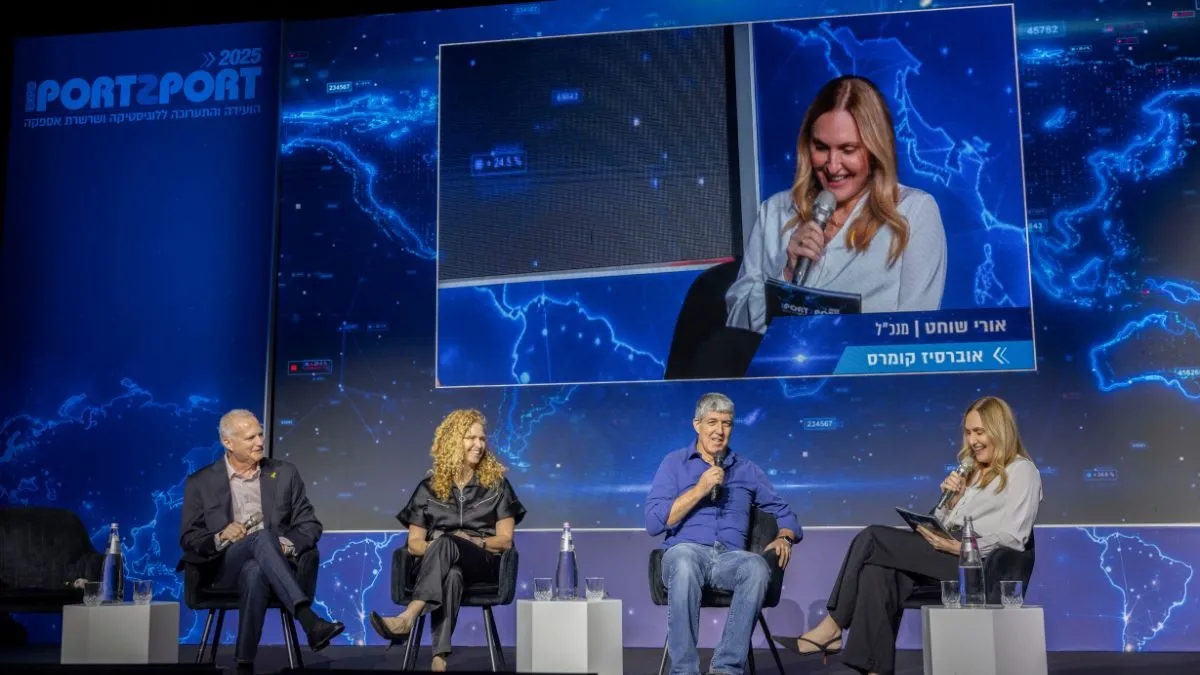
At the closing panel of the PORT2PORT 2025 conference, quiet revolutions in the world of logistics were revealed, from autonomous warehouses to artificial intelligence that changes the way shipping, operations, and customs are managed. Four leading CEOs presented how innovation has turned from a supporting tool to a central growth engine in the industry. The panel included: Uri Shochet, CEO of Overseas Commerce; Asaf Fridenson, Joint CEO of Fridenson Group; Yaron Gortler, CEO of Union Industiral Vehicle; and Liat Hadar Sharvit, CEO of Amit Group.
Uri Shochet emphasized that at Overseas Commerce, innovation is not a slogan but a real working tool: "Innovation first met us in information systems that communicate better with customers, paperless systems that transfer data accurately and quickly. We then moved on to automatic systems, in a world where it is hard to find workers like warehouse workers and forklift operators. These technologies allow workers to do more meaningful things that require the brain, and we hand over the standard jobs to machines." He later told about practical uses of artificial intelligence: "We have experimented with AI. Not everything is stable yet, but there are places where it already works. For example, a system that generates automatic price quotes for shipping from the port to the customer. The bot responds and sends a quote within minutes. Not everyone likes it yet - many still prefer a phone call - but this is the way forward."
Asaf Fridenson, Joint CEO of the Fridenson Group, described how AI is changing the world of transportation and customs. According to him, it is a deep revolution that changes not only processes but also the way decisions are made in the organization from the finance department to field operations.
"Artificial intelligence is making a quiet change for us. In our world, it's not a boom, it's slow. We did a process with GigaSpaces that introduced an organizational GPT chat, and at first, it took months to implement. But once it succeeded - it was amazing. Today I ask questions that I once had to sit with a CFO for two weeks to produce reports and now it's in a minute."
According to him, the change is also noticeable at the operational level: "Inventory management and logistics planning are done today with the help of AI, where to store Haifa or Ashdod, how much inventory to hold. We opened in the US a digital customs brokerage based on AI for data analysis and codes against customs, and we reach profitability of 60-70 percent, compared to 20-25 in traditional models."
Yaron Gortler, CEO of Union Industrial Vehicle, which represents Toyota Material Handling in Israel, explained that the shortage of workers is pushing the industry towards automation: "It is very difficult to find forklift operators and operational workers, so we bring customers autonomous movement solutions and automatic warehouses that reduce the need for workers and improve efficiency and safety."
According to him, the revolution is already happening: "We install systems that allow regular handling tools to gain autonomous capability. You can start with a single tool and gradually grow to real automatic warehouses. At our site in Nir Zvi, you can see it working autonomous forklifts and an automatic warehouse that customers can come and be impressed by."
He later added that Israel is a front line in the world: "Due to the shortage of land and high prices, Israel is relatively very advanced in adopting autonomous technologies. There are already dozens of automatic warehouses even more than in Europe."
Liat Hadar Sharvit, CEO of Amit Group, brought a personal angle from the high-tech world that connects to logistics: "In our world, the price of a mistake is very high. If we stop for one day - a factory will not work and stores will not sell. Therefore, the implementation of new technologies must be 100 percent successful, not 90 or 85. It works both against innovative companies and against workers who need to adopt the change."
She later emphasized the balance between technology and man: "We implement document reading systems and automation with 100% accuracy, and make adjustments until the system reaches full performance level. Customers are less afraid when they see that technology improves speed and control - it does not replace them, but strengthens them."
The speakers agreed that the Israeli logistics industry is undergoing a deep change, from physical professions to smart systems, from a warehouse of surfaces to a warehouse of data. As the moderator Keren Marciano summed up: "We heard, learned and understood that Israeli logistics and the people who drive it continue to innovate and create, even when the world around them is changing at a thrilling pace."
The Quiet Revolutions in Logistics
At the PORT2PORT 2025 conference, industry leaders discuss the quiet revolutions in logistics, from autonomous warehouses to AI that changes shipping and operations management.
13:53 ,09.11.2025
The Quiet Revolutions in Logistics
-
 Found it useful? Share
-
 Share on Facebook
-
 Share on X
-
 Share on LinkedIn
-
 Share via Email
-
 Share on WhatsApp
-
 Print Article
Found it useful? Share
Related
 05.11.2025
Between Trump and China: The Supply Chain Faces a New Global Order
 03.11.2025

DHL Express Israel CEO, Yonatan Ivgi, Outlines Optimistic Forecast for 2026
 02.11.2025
Ofer Bloch: 'Israel Lacks Strategic Supply Chain Planning'
 30.10.2025
PORT2PORT Conference: Port Managers Call for National Planning, Not Just Cargo Competition
 30.10.2025
Gadot Mercury Expands Operations with Acquisition of Mintz Lab Systems
 29.10.2025
PORT2PORT 2025: Amir Hayek Foresees Growth of Abraham Accords