 Found it useful? Share
 Share on Facebook
 Share on X
 Share on LinkedIn
 Share via Email
 Share on WhatsApp
 Print Article
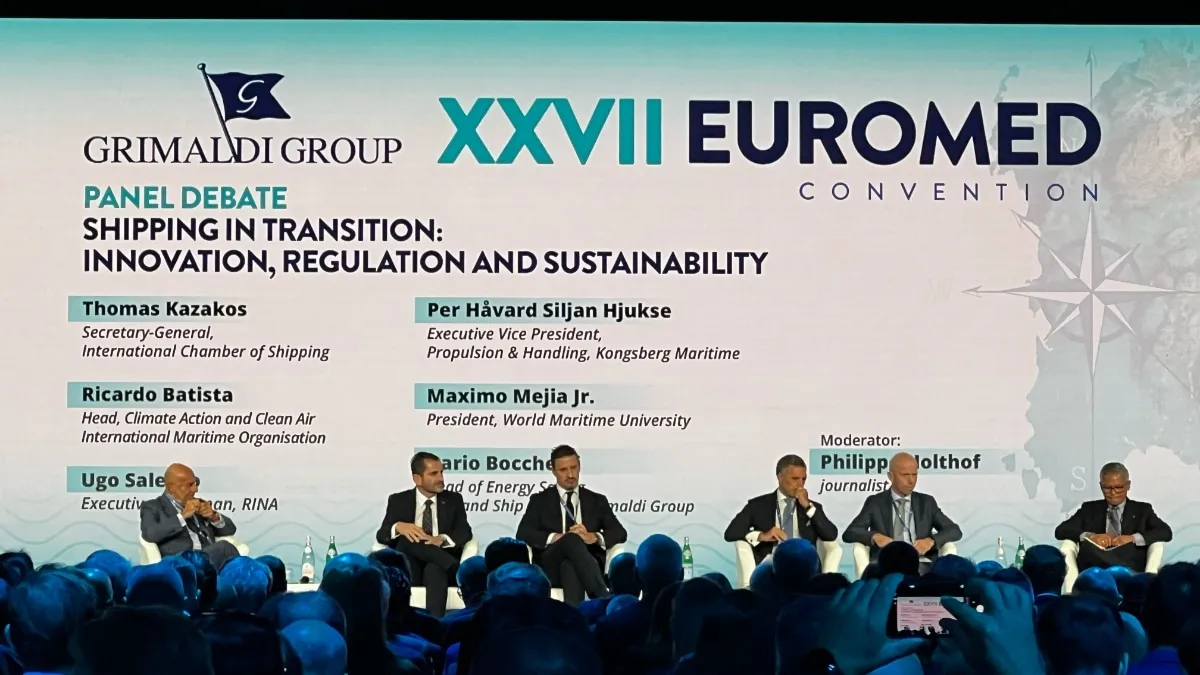
The decarbonization and technology revolution in global shipping is presenting shipping companies, regulators, and engine manufacturers with unprecedented dilemmas. During a professional panel at the 27th EUROMED Convention in Sardinia, hosted by the Grimaldi Group under the title "Shipping in Transition: Innovation, Regulation, and Sustainability," international industry leaders gathered to map the trends that will shape the global fleet in the coming decades.
The panel, moderated by journalist Philipp Holthof, included Thomas Kazakos, Secretary General of the International Chamber of Shipping (ICS); Riccardo Battista, Head of the Climate and Clean Air Division at the International Maritime Organization (IMO); Ugo Salerno, Executive Chairman of the Italian classification society RINA; Per Håvard Siljan Hjukse, Senior Vice President at Kongsberg Maritime; Prof. Maximo Mejia Jr., President of the World Maritime University (WMU); and Dario Bocchetti, Director of Energy Saving, R&D, and Ship Design at the Grimaldi Group.
"The greenest fuel is the one you don't use"
One of the strongest consensuses emerging from the discussion, led by Dario Bocchetti and technology experts, is that the excessive race for alternative fuels often overlooks the most basic rule: energy conservation. "About 80% of innovation today is dedicated to energy saving," it was noted during the panel, "because whatever the future fuel may be, it will be significantly more expensive. The greenest and cheapest fuel is simply the energy we manage not to consume."
Representing the IMO, Battista emphasized that the 2030 targets (a 40% reduction in emission intensity per ton/mile) are already within reach thanks to advanced hydrodynamic designs, efficient engines, and green auxiliary systems, even before a widespread transition to expensive new fuels.
Small Modular Reactors (SMRs): The Real Solution?
One of the most intriguing topics discussed, presented in detail by Ugo Salerno of RINA, was the integration of nuclear energy into commercial vessels. While fuels like ammonia and methanol require complex supply chains and massive green energy production, Small Modular Reactor (SMR) technology offers a breakthrough.
These are closed reactors, manufactured in factories rather than assembled in shipyards, requiring no intervention from the ship's crew and emitting no greenhouse gases or pollutants. Salerno noted that while the technology will reach commercial maturity within about a decade, it could be the exclusive solution for true zero emissions on large ships on long international routes.
Shifting Control to Shore: The Remote Control and AI Revolution
Another dramatic topic discussed was the structural change in ship management and the transfer of responsibility from sea to shore. Thanks to continuous satellite communication, AI systems, and advanced sensors, classification societies and fleet managers can now monitor ship status, hull stress, and systems in full synchronization 24 hours a day.
World Maritime University President Maximo Mejia emphasized that this development completely changes the nature of seafarers' work: the focus is shifting from basic technical knowledge to risk management capabilities, complex decision-making, and understanding when to take manual control when autonomous systems show deviations.
Giant Batteries and the Danger of "Reverse Modal Shift" to Roads
In the regional shipping and Ro-Pax sectors, batteries were presented as an immediate growth engine. Ships are currently being built equipped with massive batteries that allow for silent sailing and zero emissions during port stays and maneuvering.
However, Thomas Kazakos of the ICS and Dario Bocchetti of Grimaldi echoed Emanuele Grimaldi's warning against double taxation and stifling European regulation (ETS and FuelEU Maritime). The central warning is that over-taxing maritime shipping will cause a "Reverse Modal Shift"—a situation where the rising cost of sea transport drives cargo back to trucks on European roads, achieving the opposite result by increasing air pollution and congestion.
As stated, the 27th EUROMED Convention in Sardinia proved that the global shipping industry is no longer waiting for the future but is shaping it in real-time. From massive investments by shipping companies in green methanol and ammonia-based vessels to AI-based remote monitoring technologies and the vision of Small Modular Reactors, the industry is demonstrating impressive adaptability. However, the success of the transition to green and autonomous shipping depends primarily on creating uniform global regulation, protected from double taxation, and close cooperation between legislators, technology manufacturers, seafarers, and shipowners.
The EUROMED Convention was held over the weekend in Sardinia, Italy, with the participation of over 700 key figures from the fields of finance, transport, logistics, ports, and the automotive industry from around the world, including a prominent senior delegation from Israel.
The Grimaldi Group is represented in Israel by the Allalouf Group.