

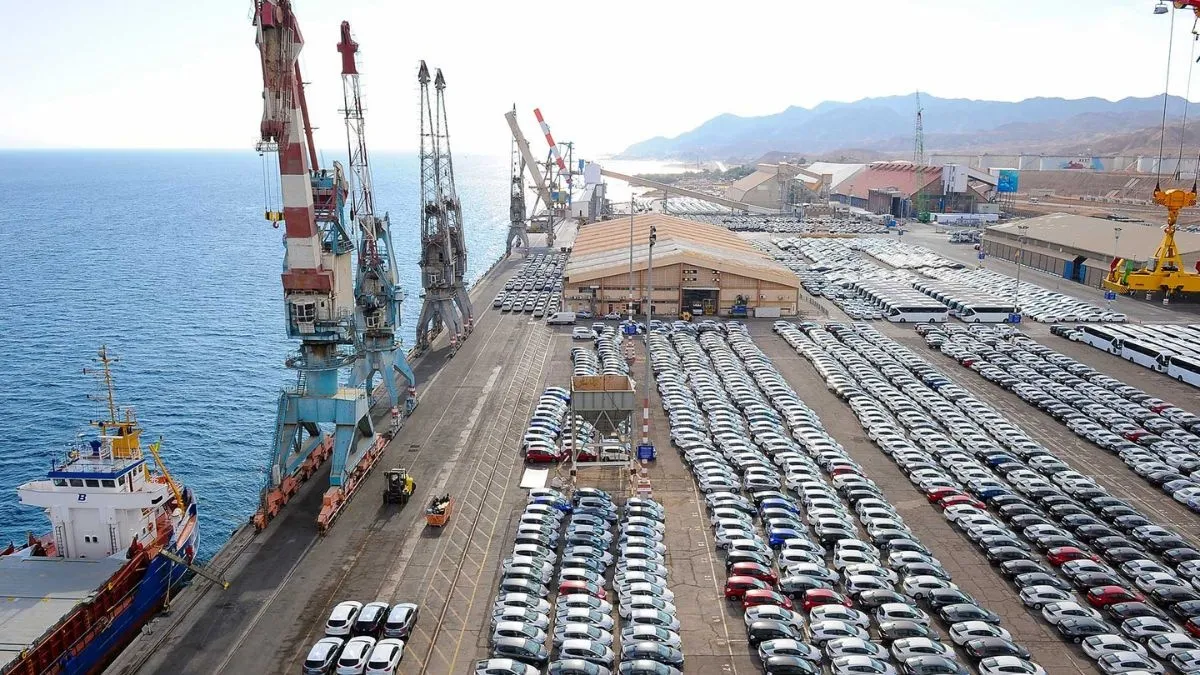
Shareholders of Eilat Port announced today a strategic move aimed at resuming car import operations to the port and breaking the maritime siege imposed on it in the past two years. The owners intend to establish an independent shipping arm for transporting cars from the Far East to Eilat. The port's controllers are currently in advanced talks with several shipping companies to charter or purchase Ro-Ro ships designed for car transport. This is in parallel with discussions on the issue of insurance. Eilat Port officials say that the resumption of Eilat Port's operations is a national interest, not just a port issue.
Over the past few months, several proposals have been raised to resume the port's operations, but so far no practical solution has been found. The port's shareholders decided not to wait any longer and to promote a plan to return to operations. Advanced talks are currently being held with several international shipping companies to charter or purchase two Ro-Ro ships dedicated to car transport, capable of carrying between 3,500 and 5,000 vehicles each, and to independently transport the cars to Eilat. The cost of chartering such a ship is estimated at $35,000 to $50,000 per day. At the same time, there is ongoing contact with insurance companies to arrange the required insurance coverage for sailing on this route. According to the assessment, the insurance issue is not expected to be a problem.
Port management emphasizes that the shutdown of Eilat Port for some time is not just a problem for shareholders, but a national crisis that affects every citizen in Israel: The diversion of cars to the ports in Ashdod and Haifa takes up enormous storage areas, delays the unloading of other vital goods and increases costs to the consumer. Moreover, concentrating all goods imports on the Mediterranean Seafront undermines national resilience and the country's ability to function in an emergency. In addition, Eilat Port is the lifeline of the city of Eilat, and its shutdown directly affects hundreds of families and the entire region's economy.
Eilat Port management estimates that if the move matures, the first car ship could enter the port within a few weeks.
Eilat Port, which was Israel's main gateway for car imports from the Far East - Japan, Korea, and China, until about two years ago, suffered a severe blow with the outbreak of the crisis in the Red Sea. Since November 2023, with the imposition of the siege by the Houthi rebels on the Bab al-Mandab Strait and the attack on ships with Israeli ties, the arrival of Ro-Ro ships to Eilat Port has completely stopped. Since then, the port's piers have stood idle. The current situation has led to the diversion of all car shipments from the East to the ports of Haifa and Ashdod, causing an extension of the sailing route and a logistical 'bottleneck' in the Mediterranean Sea ports. This includes a shortage of car storage areas. For the ports in Ashdod and Haifa, this was a good business opportunity as unloading cars is considered the most profitable activity of the ports. For importers, in addition to shortening the timetables for bringing cars from the East to Eilat, the conditions they received at Eilat Port were better, the storage areas were more spacious, and the conditions for storing cars in the Eilat climate were more suitable. It should be emphasized that although Eilat Port has been idle for about two years, the port management has made sure to keep the strategic port open, while maintaining manpower and avoiding layoffs.
In addition, last week, Israel Ports Company announced the completion of the rehabilitation works in the southern part of the main pier at Eilat Port, a central stage in a multi-year process to rehabilitate the entire pier, as part of preparations for the port's return to full operation. The works, coordinated with the port management, included rehabilitation and strengthening of the pier structure, underwater works to ensure the stability of its constructive parts, strengthening for earthquake resistance, storm damage repair, and laying of concrete mattresses for ground stabilization and maintaining a suitable depth for anchoring ships.
Eilat Port Initiates Independent Car Import Line from the East
Eilat Port's shareholders announce a strategic move to resume car import operations and break the maritime siege of the past two years. The port is in advanced talks to charter or purchase Ro-Ro ships for car transport.
11:43 ,23.12.2025
Eilat Port Initiates Independent Car Import Line from the East
-
 Found it useful? Share
-
 Share on Facebook
-
 Share on X
-
 Share on LinkedIn
-
 Share via Email
-
 Share on WhatsApp
-
 Print Article
Found it useful? Share
Related
 03.11.2025
Sweeping Arrests in Corruption Scandal, Histadrut Leader Detained
 31.08.2025
Turkey Imposes Airspace Restrictions on Israeli Government Flights
 15.07.2025
Gadot Group Takes Over Green Oil's Recycling Facility
 16.06.2025
'A Public Humiliation': Israeli Stands Covered at Paris Air Show
 14.06.2025
Updated Guidelines for Essential Industries Amid 'Am K’Lavi' Operation
 27.03.2025
Stef Wertheimer, Israel Prize Winner and Industrial Pioneer, Dies at 98